
Commercial Led Lights
Table of Contents
Unlocking Energy Efficiency with Commercial LED Lights
In the bustling commercial hubs of Atlanta, Georgia, property owners and managers face rising energy costs amid growing demands for sustainability. Traditional lighting systems drain resources, contributing to higher operational expenses and environmental impact. Switching to commercial LED lights in Atlanta, Georgia, offers a game-changing solution, delivering up to 75% energy savings and significantly longer lifespans compared to incandescents or fluorescents. According to federal guidelines, LEDs use 50-90% less energy while providing superior illumination for commercial spaces.
As a leading commercial led lighting company, Green Property Advisors specializes in turnkey retrofits tailored to diverse properties, from offices and retail outlets to warehouses and industrial facilities. Our process begins with a free site audit to assess existing fixtures and identify opportunities like installing LED high bay lights for optimal coverage in high-ceiling areas. We navigate Georgia Power rebates to maximize incentives, ensuring zero upfront costs through flexible financing. Clients enjoy immediate ROI, often within 1-2 years, thanks to reduced maintenance and enhanced light quality that boosts occupant comfort and productivity.
Key benefits include:
- Substantial energy reductions for lower utility bills
- Extended fixture life minimizing replacements
- Improved visibility supporting safety and efficiency
- Compliance with sustainability goals for greener operations
Act now to capture these Georgia rebates before they evolve. This guide explores LED fundamentals, in-depth retrofit strategies, and practical implementation steps. Contact Green Property Advisors for your free Atlanta audit and start unlocking energy-efficient commercial illumination today.
Core Principles of Commercial LED Lighting
Commercial LED lights in Atlanta, Georgia, represent a transformative shift in building illumination, leveraging semiconductor technology to produce light through electroluminescence. Unlike traditional bulbs that rely on filament heating or gas excitation, LEDs use diodes that emit photons when electricity flows, offering superior control over brightness and color. This core mechanism allows for precise energy use, measured in lumens per watt rather than raw watts, enabling businesses to illuminate spaces efficiently without excess heat. For Atlanta properties, where humid conditions demand durable solutions, these lights provide long-lasting performance that aligns with local energy goals.
At the heart of LED efficiency lies their ability to convert more electricity into visible light. Commercial LED lighting delivers up to 75 percent savings over fluorescent systems, reducing operational costs for offices and retail spaces. Consider a typical 4-foot office fixture: traditional options consume 100 to 200 watts, while LEDs operate at 20 to 60 watts, directly lowering utility bills from Georgia Power. Per DOE guidelines on purchasing energy-efficient luminaires, LEDs achieve this by minimizing waste, with real-world benchmarks showing 50 percent or greater reductions in energy use. This efficiency not only cuts expenses but also eases the load on cooling systems in Atlanta’s warm climate, where high heat output from older lights exacerbates air conditioning demands.
For Atlanta businesses evaluating upgrades, understanding these differences is crucial to identifying retrofit opportunities that maximize rebates and minimize disruptions. The following table highlights key attributes, drawing from DOE standards and local incentive programs to illustrate why LEDs outperform traditional options in commercial settings.
| Aspect | Traditional (Fluorescent/Incandescent) | Commercial LED Lights |
|---|---|---|
| Energy Consumption | High (100-200W per fixture) | Low (20-60W per fixture, 50-75% savings) |
| Lifespan | 1,000-10,000 hours | 50,000+ hours |
| Maintenance | Frequent replacements | Minimal, reduced labor |
| Cost Savings Potential | Limited rebates | High with Georgia Power rebates up to $0.50/W |
| Heat Output | High, increases AC load | Low, reduces cooling costs |
| Light Quality | Variable, potential flicker | Consistent, high CRI for offices/retail |
This comparison underscores how commercial LED lights align with rebate eligibility under Georgia Power programs, as supported by DOE data assuming standard fixtures. Businesses in Atlanta can expect rapid ROI, often within 18 to 24 months, through lower energy draws and extended lifespans that cut maintenance by up to 80 percent. For instance, retrofitting an office tower in Midtown could save thousands annually, while a retail strip in Buckhead benefits from consistent lighting that enhances customer experience without frequent bulb changes.
Building on these fundamentals, LEDs offer versatile compatibility across commercial spaces. In offices, recessed led lighting for commercial buildings provides even illumination with adjustable color temperatures, typically 4000K for daylight-like focus that boosts productivity. Retail environments favor high color rendering index (CRI) above 80 to accurately display merchandise, ensuring vibrant visuals. Warehouses utilize LED high bay lights in Atlanta facilities for overhead coverage, illuminating vast areas with minimal fixtures and durability against humidity. Like energy-smart bulbs scaled for big buildings, these durable LED fixtures for business dispel myths of high upfront costs by delivering substantial long-term savings, often offset by incentives.
To determine suitability, consider applications: LEDs excel in all spaces, from humid warehouses to climate-controlled offices, answering queries on energy savings and high bay uses through wattage efficiencies and targeted designs. Green Property Advisors offers free audits to quantify these benefits for your property, identifying custom retrofits without operational interruptions.
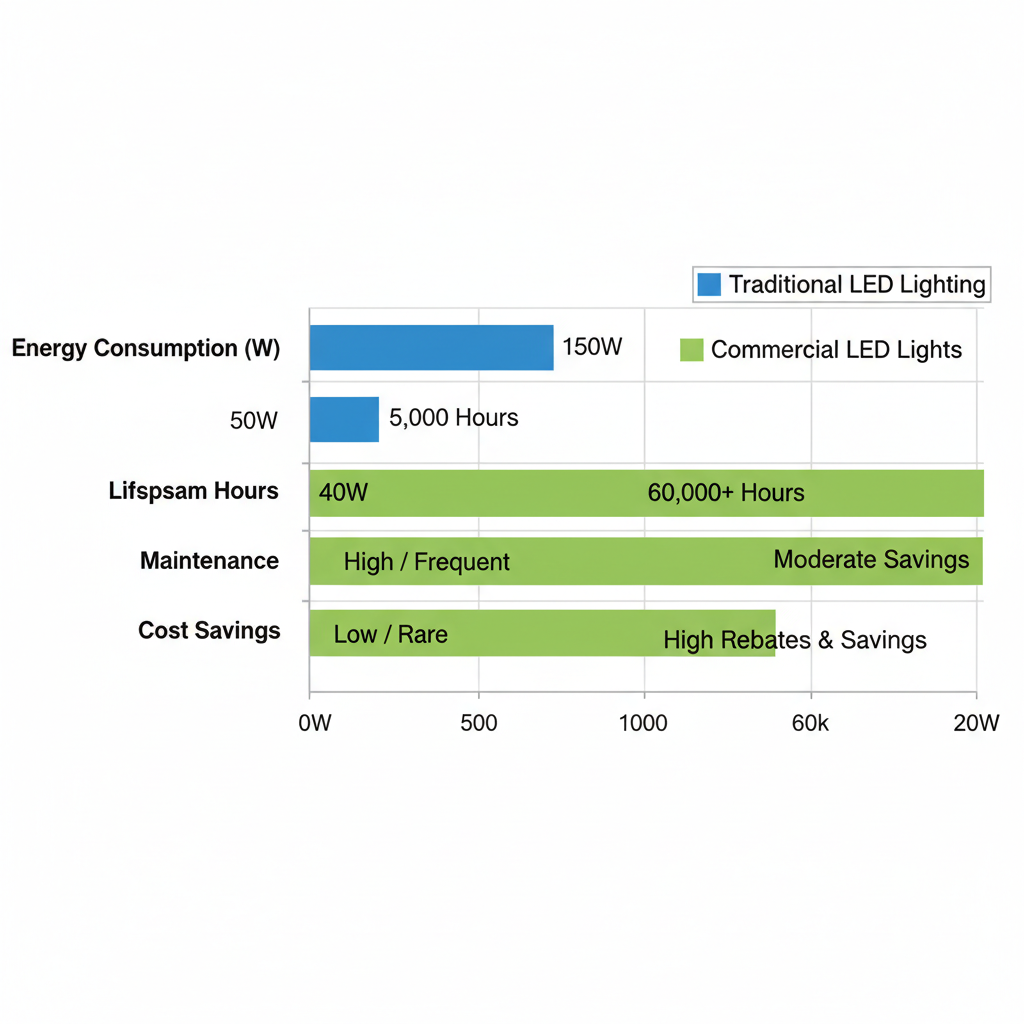
Comparison of traditional lighting versus commercial LED efficiency benchmarks
These principles lay the groundwork for efficient commercial illumination systems, but beyond the basics, exploring advanced applications and detailed savings models reveals even greater potential for Atlanta properties.
Advanced LED Applications and Savings Analysis
In the bustling commercial landscape of Atlanta, Georgia, adopting advanced commercial LED lights in Atlanta, Georgia, represents a strategic move for property owners seeking substantial energy reductions. Green Property Advisors specializes in tailoring these retrofits to maximize rebates from Georgia Power and federal incentives, ensuring businesses achieve rapid paybacks while enhancing operational efficiency. This section explores key applications, from industrial to office settings, and provides analytical tools for projecting long-term savings.
High Bay LED Solutions for Warehouses
LED high bay lights play a pivotal role in illuminating vast warehouse spaces in Atlanta’s industrial parks, where high ceilings demand powerful, efficient solutions. These fixtures, with lifespans exceeding 100,000 hours, support 24/7 operations by delivering bright, uniform light that reduces shadows and improves worker safety. Energy savings reach 60-80% compared to traditional metal halide lamps, primarily through lower wattage and instant-on technology that eliminates warm-up delays.
Qualifying for Georgia Power rebates, these installations often see post-rebate costs drop significantly, making them accessible for mid-sized facilities. For instance, a 50,000 square foot warehouse in Atlanta’s logistics hub could save over $15,000 annually on electricity alone, assuming local rates of $0.12 per kWh. Integration with motion sensors further optimizes usage during off-peak hours.
Pros include minimal maintenance and compatibility with smart controls for zoned lighting. Cons involve initial coordination for ceiling access, but Green Property Advisors’ audits mitigate disruptions by mapping exact fixture needs.
Recessed LED Retrofits for Offices
Upgrading to recessed LED retrofits transforms office environments in Georgia’s commercial districts, providing soft, even ambient lighting that boosts occupant comfort. Commercial LED lighting excels here by replacing outdated fluorescent can lights with energy-efficient alternatives that cut consumption by 50-70%. Drawing from DesignLights Consortium (DLC) standards for 2×2 luminaires, these fixtures ensure high lumens per watt, ideal for open-plan workspaces.
Installation ease stands out, as led recessed lighting retrofit kits snap into existing housings without major rewiring, minimizing downtime for Atlanta offices. Enhanced color rendering improves visual tasks, reducing eye strain and elevating productivity. A recent project for a downtown firm yielded 45% bill cuts, with rebates covering half the upfront expense.
Pros encompass flicker-free operation and dimmability for flexible moods. However, poor installations can lead to uneven light; professional audits from Green Property Advisors verify compliance and performance. Smart controls, per GSA guidance, add 20-30% extra savings by automating adjustments based on occupancy.
Selecting the right retrofit depends on space type, whether high-ceiling industrial areas or low-profile offices. The following comparison highlights key options for Atlanta properties, factoring in local rebates and typical commercial applications.
| Retrofit Type | Energy Savings % | Initial Cost per Fixture (Atlanta Rebated) | Payback Period | Best For |
|---|---|---|---|---|
| LED High Bay Lights | 60-80% | $100-200 (post-rebate) | 1-2 years | Warehouses/Industrial (High ceilings) |
| LED Recessed/Can Lights | 50-70% | $50-150 (post-rebate) | 6-18 months | Offices/Retail (Ambient lighting) |
| Exterior LED Fixtures | 70-90% | $200-400 (post-rebate) | 1-3 years | Parking/Building Perimeters (Security-focused) |
| Overall Suitability | All Georgia utilities eligible | – | – | – |
Based on Georgia Power rebates for a 10,000 sq ft space, this data from DOE and local programs underscores how high bay options suit heavy-use zones, while recessed units prioritize aesthetics. Green Property Advisors’ audits refine these choices, stacking incentives to shorten paybacks and verify savings through post-install reports. For security-focused exteriors, the higher efficiency offsets elevated costs in perimeter lighting.
These insights reveal Atlanta’s rebate landscape amplifying retrofit value, guiding property managers toward customized solutions that align with operational demands.
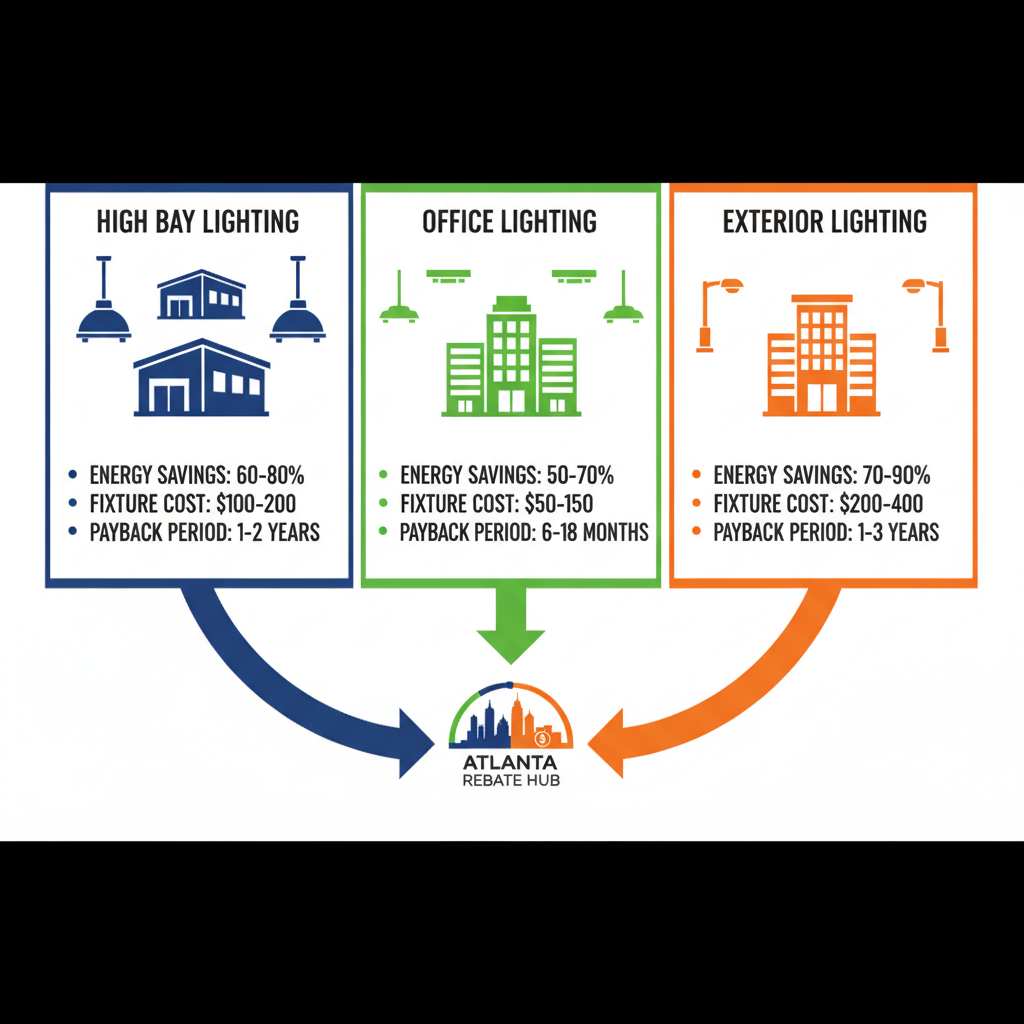
Advanced LED applications and savings analysis for property energy efficiency
Building on these comparisons, the infographic visualizes interconnected factors like rebate ties, helping visualize holistic benefits. Transitioning to financial modeling, businesses can project outcomes using Green Property Advisors’ tools for precise, audit-backed forecasts.
ROI Calculations and Payback Periods
Calculating ROI for retrofit LED systems for business involves straightforward formulas that Green Property Advisors incorporates into audit reports. The basic payback period is: Payback (years) = Initial Cost / Annual Savings, where annual savings = (Old kWh – New kWh) × Utility Rate × Operating Hours.
For an Atlanta warehouse, replacing 20 high bay fixtures might cost $3,000 post-rebate, saving 50,000 kWh yearly at $0.12/kWh, yielding $6,000 in savings and a 6-month payback. Industrial LED illumination with controls adds layers, potentially boosting ROI to 200% over five years.
A mini-table illustrates payback scenarios:
| Scenario | Annual Savings | Payback Period | Notes |
|---|---|---|---|
| Basic High Bay Retrofit | $5,000 | 1 year | No controls |
| Recessed with Dimming | $3,200 | 9 months | 25% extra from automation |
| Full Exterior Upgrade | $8,500 | 2 years | Security + rebates |
Case studies from Atlanta projects show 40-60% bill reductions, with one retail center recouping investment in under a year. Contact Green Property Advisors for a free audit to model your property’s specifics and unlock these savings.
Step-by-Step LED Retrofit Implementation
Implementing a business LED upgrade process for commercial properties requires a structured approach to ensure efficiency and minimal disruption. Green Property Advisors specializes in guiding Atlanta facilities through this journey, leveraging local expertise for optimal results. With their turnkey services, property managers can achieve significant energy savings without upfront costs.
Conducting Free Energy Audits
For facilities seeking commercial LED lights in Atlanta, Georgia, the process starts with a comprehensive free energy audit to identify opportunities for efficient lighting installations. This initial step involves a thorough site assessment by experienced professionals who evaluate current lighting setups, including fixture types and usage patterns. Drawing from energy efficiency criteria outlined in federal guidelines for purchasing energy-efficient light fixtures, auditors prioritize high-impact areas like offices and warehouses where outdated bulbs consume excess power.
- Schedule the Audit: Contact Green Property Advisors to arrange a no-obligation visit. Provide basic details about your property to tailor the assessment.
- On-Site Evaluation: Technicians conduct a detailed fixture inventory, counting existing lights and noting their locations, wattages, and operational hours. For instance, in a typical Atlanta office, this might reveal hundreds of inefficient fluorescents ripe for replacement.
- Usage Analysis: Using utility bills and on-site metering, the team analyzes energy consumption patterns. This includes peak usage times and areas with high heat loss from lighting.
- Savings Projections: Based on the inventory, auditors project potential reductions, often 50-70% in lighting energy costs, factoring in LED performance standards.
Prepare for the audit with a simple checklist: ensure access to all areas, gather recent utility bills, and list any specific concerns like uneven lighting in break rooms. This process typically takes one day, providing a clear report with prioritized recommendations. Common challenges, such as coordinating during business hours, are addressed by scheduling off-peak visits. By avoiding DIY errors, like underestimating fixture counts, businesses gain accurate baselines for ROI calculations. This foundational step empowers informed decisions, setting the stage for rebate navigation.
Navigating Rebates and Financing
Once the audit confirms viability, the next phase focuses on securing financial support to make the upgrade affordable. In Georgia, utility programs like those from Georgia Power offer substantial rebates for LED retrofits, often covering 30-50% of project costs. Green Property Advisors excels here, handling applications to streamline the process.
- Utility Coordination: The team identifies eligible incentives based on your audit findings. For Atlanta properties, this includes Georgia Power’s commercial lighting rebates, which require documentation of pre-retrofit conditions.
- Rebate Applications: Submit detailed forms with fixture inventories and proposed LED specifications. Professionals ensure compliance with efficiency standards, avoiding common pitfalls like incomplete paperwork that delays funds.
- Financing Options: Explore zero-upfront-cost models, such as utility on-bill financing or third-party leases. These tie repayments to verified savings, ensuring cash flow remains positive from day one.
A checklist for this stage includes verifying utility account details, reviewing rebate caps, and confirming property eligibility. Timelines vary, but processing typically takes 4-6 weeks, with funds disbursed post-installation. Addressing challenges like varying rebate amounts, experts calculate net costs–often under $0.50 per fixture after incentives. For questions on how much commercial LED lighting fixtures cost, expect $20-100 per unit before rebates, dropping significantly with professional navigation. This phase transforms projections into funded plans, highlighting why partnering with specialists saves time and maximizes returns.
Professional services stand out in Georgia’s regulatory landscape, where local permitting is straightforward but rebate complexity demands expertise. As leading led lighting retrofit companies, Green Property Advisors integrates these elements seamlessly, reducing administrative burdens for busy managers.
The following table compares DIY versus professional retrofit processes, emphasizing benefits for Atlanta businesses based on industry standards and Georgia Power examples:
| Phase | DIY Approach | Professional Retrofit (Green Property Advisors) |
|---|---|---|
| Audit & Planning | Self-assessment, potential errors; Time-intensive, no rebates guaranteed | Free professional site audit, accurate inventory; No obligation, rebate identification included |
| Installation | Hire separate contractors, disruption risk; Weeks to months | Turnkey managed, certified techs; 1-4 weeks, minimal downtime |
| Verification & Savings | Self-measure, unverified; No rebates handled | Documented reports, guaranteed counts; Full navigation, zero upfront via financing |
This comparison underscores time and cost savings with professionals: DIY often leads to overlooked rebates and extended timelines, while turnkey approaches deliver verified outcomes. Using commercial fixture types like high bays from industry resources, projects achieve faster paybacks, often under 18 months. These advantages make professional retrofits ideal for Atlanta’s fast-paced commercial sector, transitioning smoothly to execution.
Installation and Verification Process
With funding secured, installation proceeds efficiently, focusing on commercial LED lighting tips to ensure lasting performance. Green Property Advisors manages every detail, from permits to deployment, minimizing operational disruptions in Atlanta facilities.
- Pre-Installation Prep: Obtain necessary permits–Atlanta’s process is expedited for energy projects. Coordinate utility notifications and stage materials on-site.
- Tech Deployment: Certified teams replace fixtures in phases, starting with high-traffic areas. For industrial settings, this includes installing LED high bay lights in local warehouses, selected for durability and 100,000-hour lifespans per commercial lighting guidelines.
- Minimal Disruption Execution: Work during off-hours where possible, using dust barriers and temporary lighting. Expect 1-4 weeks total, depending on scale.
- Post-Install Cleanup: Remove old fixtures responsibly and test all new ones for functionality.
Common challenges, like coordinating multiple trades, are mitigated through single-point management. A checklist ensures smooth rollout: confirm access schedules, backup power for critical areas, and communicate timelines to staff.
Verification follows immediately, with pre- and post-metering to confirm savings. This addresses concerns about commercial LED lighting disadvantages, such as initial adjustment periods, by providing data-driven reassurance.
The table below illustrates typical metrics for an Atlanta office retrofit:
| Metric | Pre-Retrofit | Post-Retrofit |
|---|---|---|
| Annual Energy Use | 50,000 kWh | 20,000 kWh |
| Monthly Cost | $6,000 | $2,400 |
| Maintenance Calls | 12 per year | 2 per year |
| Savings Achieved | – | 60% reduction |
These figures, aligned with Georgia Power benchmarks, guarantee results through detailed reporting. Post-project, receive a final inspection summary and ongoing support. With basics covered, explore optimizations for maximum ROI in advanced strategies.
Optimizing LED Systems for Maximum Impact
Optimizing commercial LED lights in Atlanta, Georgia, elevates basic installations to high-performance solutions that deliver substantial energy savings and operational efficiency. Beyond standard retrofits, advanced lighting optimizations integrate smart technologies to address the unique demands of Atlanta’s humid climate, ensuring longevity and comfort in commercial spaces. Green Property Advisors specializes in these enhancements, providing custom audits to identify opportunities for seamless upgrades with minimal disruption to daily operations.
Start with core strategies to boost performance. Dimming controls adjust brightness based on natural light, while occupancy sensors activate lights only when needed, yielding an additional 20-30% energy reduction. These smart LED systems for commerce extend the lifespan of fixtures, mitigating common disadvantages of commercial LED lighting like over-illumination in low-use areas. For instance, led can lights retrofit projects can incorporate these features during upgrades, enhancing ROI without extensive rewiring.
- Dimming and Sensors: Automatically modulate output for 20-30% savings; ideal for offices.
- Predictive Maintenance: Analytics forecast bulb failures, reducing downtime by up to 40%.
- Climate Adaptations: Humidity-resistant designs prevent corrosion in Georgia facilities.
These approaches answer key queries, such as how to choose LED high bay lights for commercial use by prioritizing controls for high ceilings, and confirm their suitability for retail spaces through scalable integrations.
Moving to integrations, IoT platforms connect commercial LED lighting with building management systems, particularly beneficial for warehouses using LED high bay lights in Georgia facilities. This setup enables remote monitoring and automated adjustments, scaling effortlessly across multifamily portfolios. Predictive analytics from IoT further minimizes maintenance, extending the lifespan of LED high bay lights beyond 50,000 hours. Financing options for these add-ons, like those offered by Green Property Advisors, allow zero-upfront-cost implementations, accelerating payback in humid environments where traditional systems falter.
Future trends point toward AI-driven lighting that learns occupancy patterns for even greater efficiency, promising 10-15% further gains.
Why pursue these optimizations? They transform energy costs into strategic investments, as per GSA guidance on LED and controls, which notes that integrated systems reduce energy 25% further. The following table compares basic versus advanced approaches for enhanced savings in Atlanta commercial settings:
| Strategy | Basic Implementation | Advanced with Controls/Integration |
|---|---|---|
| Energy Savings | 50-75% from LEDs alone | 75-90% with dimming/sensors |
| Cost | Retrofit only | +10-20% initial, faster payback |
| Maintenance Reduction | Extended lifespan | Automated, predictive |
| ROI in Atlanta | 1-2 years via rebates | 6-18 months, plus comfort gains |
| Suitability | All spaces | High-traffic offices/warehouses |
In Atlanta, advanced strategies leverage Georgia Power rebates, shortening ROI as outlined in energy-efficient luminaire purchasing guidelines. Basic setups suit simple retrofits, but controls amplify outcomes, with data showing 75-90% total savings and predictive maintenance cutting service calls. Green Property Advisors handles rebate navigation and installations, ensuring verified performance. This forward-thinking approach not only justifies investments but prepares properties for evolving standards. For common advanced queries next, explore how these tie into broader energy audits.
Frequently Asked Questions on LED Retrofits
For property managers exploring commercial LED lights in Atlanta, Georgia, these answers address key concerns about retrofitting with Green Property Advisors. Our expertise ensures seamless upgrades to energy-saving commercial fixtures.
What are the benefits of commercial LED lighting? LED solutions for business offer significant energy savings up to 70% and improved occupant comfort through brighter, uniform illumination, reducing maintenance needs over time.
How much do commercial LED lighting fixtures cost to run? Post-retrofit, expect $0.03-0.05 per kWh, far below traditional options, as noted in commercial lighting fixture guides–our audits provide precise projections.
Are commercial LED lights suitable for retail spaces? Yes, 2×2 luminaires meet DLC standards for ambient lighting in interior commercial areas, enhancing visibility without glare.
What about led can lights retrofit for offices? Ideal for recessed setups, our turnkey process minimizes disruption while boosting efficiency.
What’s the best for warehouses? LED high bay lights in Atlanta warehouses deliver targeted illumination, saving 50-60% energy with lifespans over 50,000 hours.
How long does installation take? Typically 1-4 weeks, with professional coordination to avoid operational interruptions.
Are rebates available? Yes, our audits qualify projects for utility incentives, often covering much of the cost.
Ready to proceed? Schedule a free audit with Green Property Advisors for Atlanta-specific guidance.
Achieving Sustainable Savings with LED Retrofits
In summary, upgrading to commercial LED lights in Atlanta, Georgia, offers transformative energy efficiency and cost reductions for businesses. Through Green Property Advisors’ turnkey solutions, clients achieve up to 75% savings on lighting costs, supported by Georgia Power rebates and zero-upfront financing. The streamlined process–from free audits to professional verification–ensures seamless implementation, with a rapid 1-2 year payback. As per federal DOE standards, these efficient business lighting upgrades deliver verified performance. Contact Green Property Advisors today for your free proposal and start saving sustainably.