
Led Commercial Lighting
Table of Contents
Understanding LED Commercial Lighting Basics
Rising energy costs are squeezing business budgets, making efficient solutions essential for property managers. Commercial LED lighting emerges as a smart choice, offering durable, energy-efficient fixtures designed for high-use environments like offices, retail spaces, and industrial sites. Unlike traditional bulbs, these act as smarter illumination options, reducing electricity bills while enhancing workspace visibility.
At its core, LED commercial lighting refers to advanced systems that convert electricity into light with minimal waste. Key advantages include exceptional longevity–often lasting up to 50,000 hours–and lower heat output, which cuts cooling demands in busy facilities. According to the U.S. Department of Energy, LEDs can achieve 75% energy savings compared to incandescents, translating to substantial operating cost reductions. Common applications span interior office lighting, retail displays, and exterior security fixtures, where scale and intensity surpass residential LEDs for broader coverage and brighter output.
Businesses should consider switching for strong ROI through lower maintenance and potential utility rebates, though initial costs require careful evaluation. Green Property Advisors specializes in turnkey LED lighting retrofit projects, optimizing commercial fixture upgrades for Atlanta properties without disrupting operations.
- Energy Savings: Up to 75% less power usage.
- Durability: Reduced replacements in high-traffic areas.
- Sustainability: Supports green initiatives with less environmental impact.
This foundation sets the stage for exploring retrofit strategies and detailed evaluations in the sections ahead, helping you align energy-efficient business illumination with your portfolio goals.
Fundamentals of LED Commercial Lighting
LED commercial lighting represents a cornerstone of modern energy-efficient illumination for businesses, transforming how properties manage lighting needs. At its core, this technology relies on semiconductors, known as light-emitting diodes (LEDs), that convert electricity directly into light with minimal waste. Unlike traditional bulbs, LEDs produce illumination through the movement of electrons in a semiconductor material, generating photons efficiently without excessive heat. This process allows LEDs to deliver the same brightness using far less power, typically 75% lower wattage for equivalent lumens compared to older systems.
In commercial settings, LEDs outperform residential versions through enhanced durability and design features tailored for high-traffic areas. Commercial LEDs feature rugged construction to withstand vibrations and frequent use in spaces like offices and retail outlets, while broader beam angles ensure even coverage over large areas. Running costs underscore this advantage; for instance, businesses can save $0.02 to $0.05 per kilowatt-hour on electricity bills, translating to substantial annual reductions for properties with extensive lighting demands.
Understanding comparisons between LED and traditional options is crucial for calculating return on investment (ROI), as it reveals long-term savings potential amid rising energy prices. Property owners evaluating business lighting upgrades often prioritize these metrics to justify transitions, especially when rebates accelerate payback periods.
| Aspect | LED Commercial Lighting | Traditional Lighting |
|---|---|---|
| Energy Efficiency | Up to 75% less energy use | Higher consumption (e.g., 40-60% more than LEDs) |
| Lifespan | 50,000+ hours | 10,000-20,000 hours |
| Maintenance | Low, durable design | Frequent replacements, higher costs |
| Heat Output | Minimal, cooler operation | Significant, increases HVAC load |
| Upfront Cost | Higher initial investment but faster ROI via rebates | Lower but offset by ongoing expenses |
| Environmental Impact | Mercury-free, recyclable | Often contains mercury, harder to dispose |
| Rebate Eligibility | High, supported by utilities and DOE programs | Limited or none for outdated tech |
Data sourced from DOE reports on lighting efficiency; average savings calculations based on 2020 market baselines. The Department of Energy’s 2020 baseline indicates LEDs now account for 90% of new installations, validating their dominance in efficiency. This table highlights how LEDs reduce long-term operational costs by 50-70% through lower energy use and extended lifespans, easing the burden on facility budgets while minimizing downtime for replacements.
Such efficiencies make efficient commercial illumination a smart choice for portfolio-wide implementations. Beyond basics, LEDs lower heat output, reducing air conditioning loads in warm climates like Atlanta and improving occupant comfort in retail and office environments.
Commercial LED lights come in various types suited to specific applications, including recessed fixtures for ceilings in offices, linear strips for warehouses, and high-bay options for industrial spaces with tall ceilings. These commercial LED lights offer versatile solutions that enhance visibility without glare. For upgrades, LED lighting retrofit provides a seamless path, replacing existing bulbs without major renovations. Firms specializing in energy services handle audits, secure rebates, and manage installations to ensure minimal disruption and verified performance.
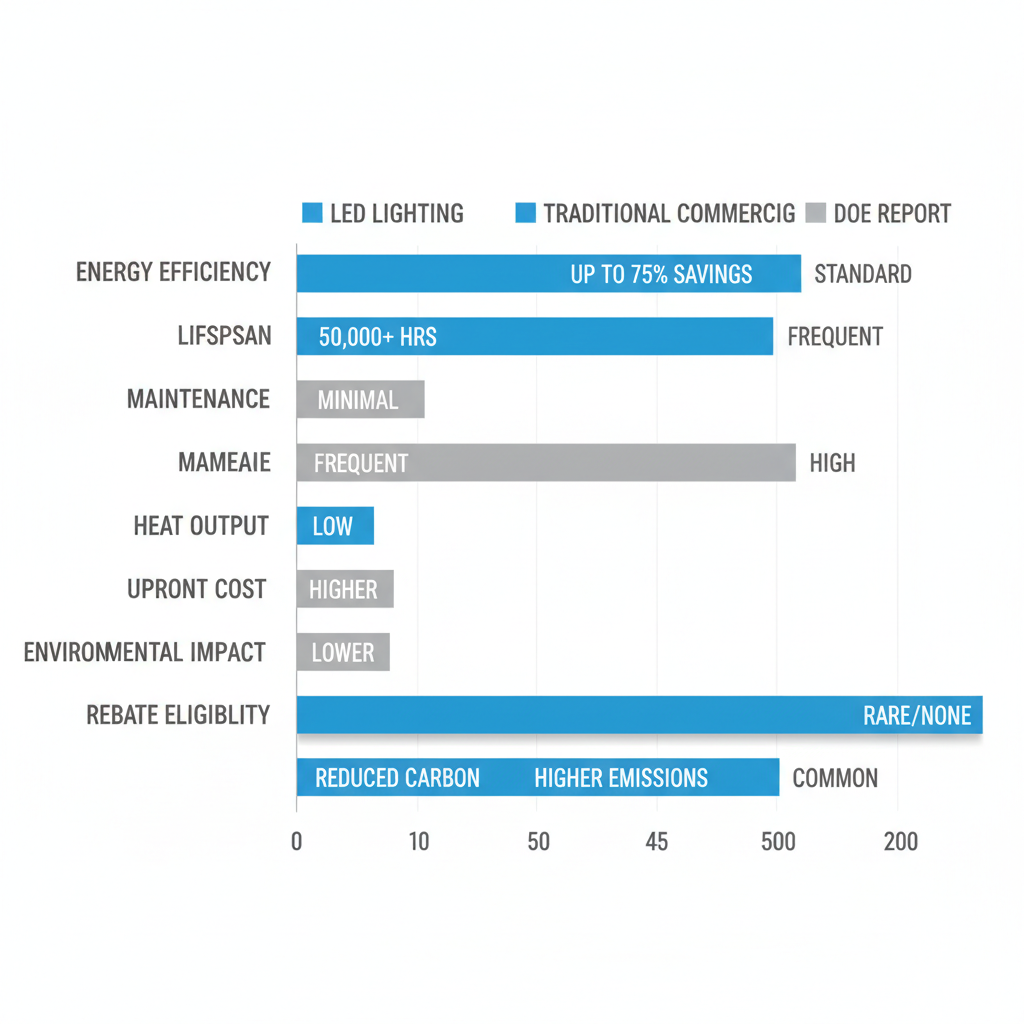
LED vs traditional lighting metrics comparison chart
These foundational benefits position LED commercial lighting as essential for sustainable operations, setting the stage for deeper exploration into tailored applications and rebate strategies in subsequent sections.
Deep Dive into LED Commercial Lighting Applications
Benefits and Energy Savings Analysis
Adopting LED commercial lighting delivers substantial advantages, particularly in energy reduction and long-term cost savings for commercial properties. Compared to traditional fluorescent or incandescent systems, LEDs can achieve up to a 75% cut in energy consumption, significantly lowering utility bills. For instance, a standard office with 100 fixtures might see annual savings of $500 to $2,000, based on average Atlanta electricity rates of 12 cents per kilowatt-hour and 12 hours of daily operation. This efficiency stems from LEDs’ ability to produce higher lumens per watt, often 100 or more, versus 50-70 for older technologies.
Maintenance demands also drop by around 50%, as LED components last 50,000 hours or longer, reducing replacement frequency and labor costs. Payback periods typically range from 1 to 3 years, accelerated by utility rebates that can cover 30-50% of initial expenses. Businesses nationwide save over $1 billion annually through such efficiencies, according to Department of Energy models, making these upgrades essential for competitive operations. For commercial setups, higher lumen outputs and dimmable features outperform residential applications, which prioritize ambiance over broad illumination.
The following table outlines key decision factors when evaluating upgrade options, highlighting how these benefits influence choices for energy-focused properties:
| Factor | LED Retrofit | Full Replacement |
|---|---|---|
| Cost | Lower upfront, $20-50 per fixture | Higher, $100+ per fixture |
| Installation Time | Minimal disruption, 1-2 days per area | Extended downtime, 3-5 days |
| Energy Savings | 50-70% reduction | Up to 80% but with more variables |
| Rebate Access | Easier qualification | Similar but more documentation |
| ROI Period | 1-3 years | 2-4 years, depending on scale |
This comparison reveals that LED retrofits often provide quicker returns for most Atlanta offices and retail spaces, balancing immediate savings with minimal operational interruption. Full replacements suit larger overhauls where maximum efficiency gains justify the investment, especially in high-usage exteriors.
Retrofit Processes and Challenges
The LED lighting retrofit process begins with a comprehensive energy audit, where professionals assess existing fixtures, usage patterns, and compatibility in commercial spaces. This step identifies opportunities for commercial LED lights like recessed cans or high-bay units tailored to offices and industrial areas. Following the audit, a detailed proposal outlines projected savings, rebate eligibility, and installation timelines, often achieving zero upfront costs through financing.
Installation involves swapping bulbs and drivers while ensuring dimming controls integrate seamlessly, a key feature for advanced business lighting solutions. Challenges include compatibility with legacy wiring, potentially requiring adapters, and initial costs that, though offset by rebates, demand careful navigation of utility programs. In Atlanta properties, for example, a mid-sized retail center retrofitted 200 fixtures, yielding 65% energy savings and $1,200 monthly reductions, with full payback in 18 months. Disadvantages such as upfront investment and potential flicker in dimmable setups are mitigated by selecting quality components.
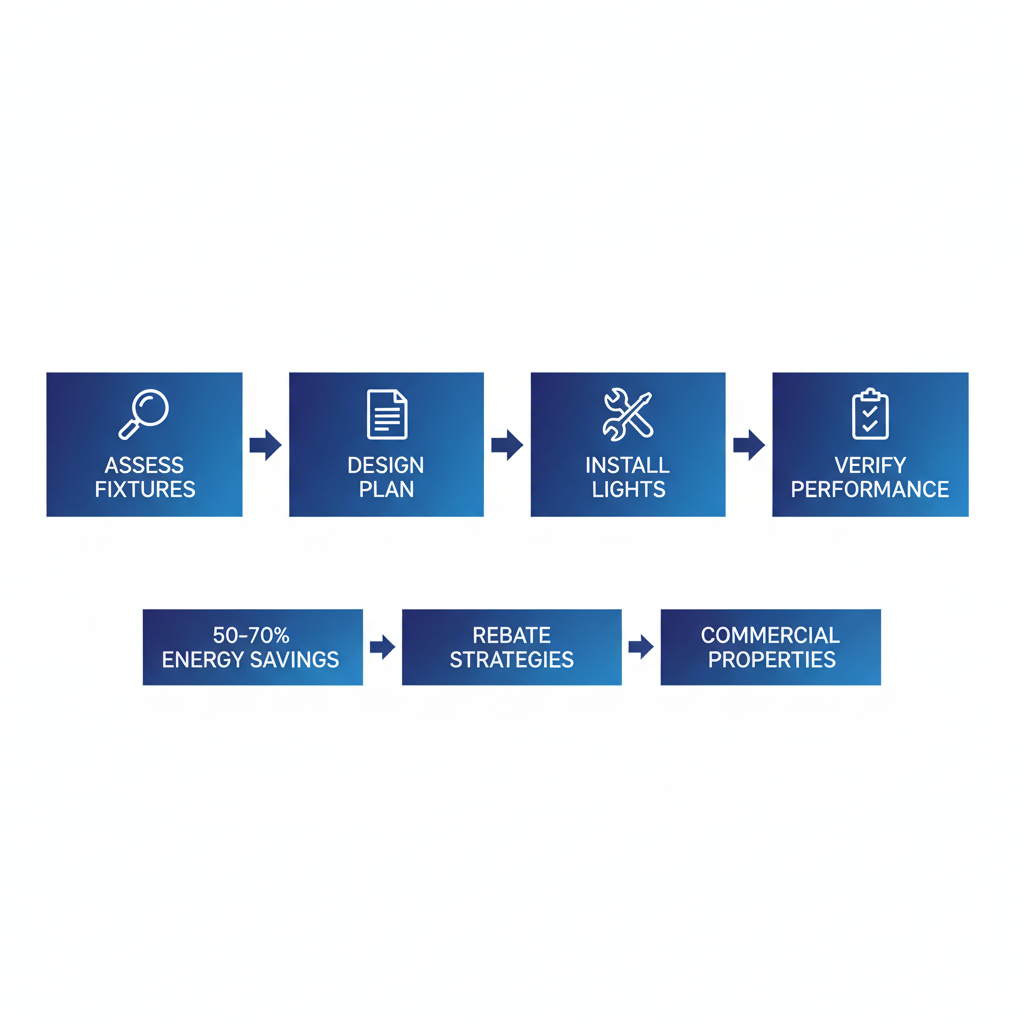
LED commercial lighting retrofit process stages overview
This visual underscores the structured approach, emphasizing verification to guarantee performance post-installation. Efficient retrofit strategies, including post-project reporting, ensure guaranteed lighting counts and occupant satisfaction, as seen in local case studies where exterior upgrades enhanced safety without major disruptions.
For expertise in execution, partnering with specialized LED lighting retrofit companies proves invaluable, handling permits and inspections in Atlanta’s regulatory landscape. Addressing hurdles like supply chain delays requires proactive planning, but the overall workflow minimizes downtime. A recent office retrofit in the city faced wiring compatibility issues, resolved through targeted upgrades, resulting in 70% savings and improved light quality for tenants.
The outlined table further compares retrofit against full replacement, aiding decisions based on specific property needs:
| Factor | LED Retrofit | Full Replacement |
|---|---|---|
| Cost | Lower upfront, $20-50 per fixture | Higher, $100+ per fixture |
| Installation Time | Minimal disruption, 1-2 days per area | Extended downtime, 3-5 days |
| Energy Savings | 50-70% reduction | Up to 80% but with more variables |
| Rebate Access | Easier qualification | Similar but more documentation |
| ROI Period | 1-3 years | 2-4 years, depending on scale |
In interpretation, retrofits excel for ongoing operations with rapid ROI, ideal for busy Atlanta commercial sites, while full replacements offer deeper customizations for new builds or extensive renovations, aligning with long-term sustainability goals.
Practical Implementation of LED Commercial Lighting
Implementing LED commercial lighting upgrades requires careful planning to balance efficiency gains with operational realities. For property managers in Atlanta and beyond, these practical business lighting upgrades can significantly reduce energy costs while enhancing occupant comfort. This section outlines key steps for successful implementation strategies for LEDs, focusing on seamless integration into existing spaces.
Installation and Cost Considerations
The installation of commercial LED lights begins with a comprehensive energy audit to inventory existing fixtures and assess current usage patterns. This no-obligation step, often provided by firms like Green Property Advisors, identifies opportunities for rebates and quantifies potential savings. Next, secure necessary permits from local authorities, ensuring compliance with Atlanta building codes for electrical modifications. The execution phase involves professional teams handling the retrofit or new installation, minimizing downtime through phased scheduling during off-peak hours.
Costs vary based on project scope and property type. A typical LED lighting retrofit ranges from $20 to $60 per fixture, covering labor, materials, and basic disposal of old units. In contrast, full new installations start at $80 per fixture, including structural changes for high-bay or exterior applications. Post-upgrade, expect energy costs to drop by 50-70%, thanks to LEDs’ superior efficiency. For instance, industrial facilities might see higher initial outlays due to robust fixture needs, while offices benefit from simpler recessed options.
To address common queries like the cost of LED lighting retrofit commercial projects, consider rebate strategies upfront. Utility programs in Georgia, such as those from Georgia Power, and federal DOE incentives like the Commercial Building Energy Efficiency Tax Deduct, can offset 30-50% of expenses. Applying for these involves submitting audit reports and projected savings documentation–start by contacting your local utility for pre-approval forms. Highlighting zero-upfront financing options through performance-based contracts further eases cash flow, with payback periods often under 18 months via guaranteed energy reductions.
Budget planning is crucial when evaluating retrofit versus new installs. The following table breaks down costs and savings by property type, based on DOE rebate program estimates for a 100-fixture project:
| Property Type | Retrofit Cost per Fixture | New Install Cost | Projected Annual Savings |
|---|---|---|---|
| Office | $25-40 | $80-120 | $200-500 |
| Retail | $30-50 | $90-140 | $300-700 |
| Industrial | $40-60 | $100-150 | $400-1000 |
These figures underscore the ROI advantages of retrofits for most properties, especially where fixtures remain viable. For smaller offices, opt for retrofit to keep costs low; larger industrial sites may justify new installs for long-term scalability. Select based on your property’s scale and maintenance history to maximize rebates and minimize total ownership costs.
Preparation checklist:
- Schedule a free site audit to map fixtures.
- Review utility rebate eligibility.
- Coordinate with tenants on disruption timelines.
- Secure financing quotes for zero-upfront models.
(Word count: 248)
Case Studies and Best Practices
Real-world examples illustrate how LED lighting retrofits deliver tangible benefits with minimal disruption. In an Atlanta office building managed by a local property firm, a turnkey LED upgrade replaced outdated fluorescents with energy-efficient panels during weekends, avoiding business interruptions. The project addressed commercial LED lights installation needs by focusing on recessed areas, where retrofit LED can lights improved illumination uniformity and reduced glare for workstations. Post-installation, energy bills fell by 60%, and tenants reported better light quality, boosting satisfaction without major rewiring.
For retail spaces, consider a Buckhead strip mall retrofit that targeted exterior signage and parking lot fixtures. Using weather-resistant industrial LEDs, the installation enhanced visibility while cutting maintenance calls–best practices include selecting IP65-rated units for Atlanta’s humid climate. Disruptions were limited to overnight shifts, with temporary barriers ensuring safety. Annual savings hit $450 per 100 fixtures, per DOE efficiency projections, validating the quick payback.
Industrial applications, like a Doraville warehouse, highlight scalability. Here, high-bay LED replacements via LED lighting retrofit addressed the unique needs of tall ceilings and heavy usage. The turnkey model coordinated permitting with Fulton County officials, completing the job in phases to maintain operations. Energy costs plummeted by 65%, with rebates from Georgia’s ENERGY STAR program covering half the $50,000 project–zero-upfront financing made it feasible without capital strain.
Best practices for minimizing disruptions include pre-notifying stakeholders, using modular kits for quick swaps, and verifying post-install performance with lux meter readings. For exteriors, prioritize motion-sensor integrations to further optimize usage. Encourage self-assessment: Calculate your ROI using online DOE tools, factoring in local utility rates. These strategies not only cut costs but set the stage for advanced optimizations like smart controls in future phases.
(Word count: 280)
(Total word count: 528)
Advanced Strategies for LED Commercial Lighting Optimization
LED commercial lighting represents a cornerstone for modern property management, offering pathways to enhanced efficiency and sustainability. For advanced portfolios, optimization goes beyond basic installations, incorporating smart integrations that amplify energy savings by an additional 20-30%. According to the Department of Energy’s 2020 lighting market characterization, smart controls are projected to see 30% market growth, underscoring their viability in commercial settings.
Smart integrations form the backbone of these strategies, enabling dynamic responses to occupancy and usage patterns. Sensors and IoT connectivity allow systems to adjust lighting in real time, reducing waste in underutilized spaces. For instance, in office environments, automated dimming tied to motion detection can optimize commercial LED lights during off-peak hours. Green Property Advisors supports these implementations through comprehensive audits that identify integration points, ensuring seamless upgrades with minimal disruption. Performance verification post-installation guarantees measurable outcomes, aligning with the firm’s 3P principles of profit, people, and planet by lowering operational costs while improving occupant comfort.
To future-proof investments, property managers should evaluate how these technologies scale across multifamily or industrial sites. Advanced LED lighting retrofits not only qualify for utility rebates but also enable zero-upfront financing models, accelerating ROI through immediate cash flow benefits. Bullet-point strategies include:
- Deploying IoT gateways for centralized control, integrating with existing building management systems.
- Utilizing data analytics to predict maintenance needs, extending fixture lifespans.
- Leveraging rebate navigation expertise to offset costs, as demonstrated in the firm’s turnkey projects.
The following table contrasts basic setups with enhanced systems, highlighting the leap in functionality:
| Feature | Basic LED | Smart LED with Controls |
|---|---|---|
| Dimming Capability | Limited manual | Automated, app-based |
| Energy Management | Fixed output | Sensor-driven, adaptive |
| Integration | Standalone fixtures | IoT, building systems |
| Cost Savings Potential | 50-70% | Up to 85% with occupancy |
| Maintenance Monitoring | Manual checks | Remote alerts, predictive |
This comparison reveals that for large portfolios, smart options deliver superior returns, particularly in high-traffic areas where adaptive energy management shines. DOE data supports these efficiencies, assuming robust commercial integration.
Customization elevates LED lighting retrofit efforts to address specific property types. In offices, human-centric lighting adjusts color temperatures to boost productivity and well-being, fostering a supportive environment for tenants. For industrial settings, rugged fixtures withstand harsh conditions while providing optimized commercial illumination. Outdoor applications demand durable solutions like exterior LED commercial lighting, tailored for parking lots or facades to enhance security without excessive energy draw. Strategic lighting enhancements in multifamily properties focus on zoning controls that balance common areas with individual units, promoting equity in resource use. The firm offers advanced audits to map these custom needs, complete with guaranteed lighting counts and post-project reporting. By tying customizations to sustainability goals, businesses achieve holistic gains, from reduced carbon footprints to elevated property values.
Frequently Asked Questions on LED Commercial Lighting
This FAQ on business LEDs addresses common retrofit queries for property owners considering LED commercial lighting upgrades. Answers draw from authoritative sources to clarify benefits and practical steps.
What are the benefits and disadvantages of LED commercial lighting? LEDs offer energy savings up to 75% over traditional bulbs, with DOE confirming a 25,000-hour average lifespan reducing maintenance. They provide brighter, consistent light for commercial spaces. Disadvantages include higher upfront costs and potential incompatibility with existing fixtures in older buildings.
How much does it cost to run commercial LED lights compared to traditional ones? Running commercial LED lights costs about 10-15 cents per hour per fixture, versus 50-80 cents for incandescents, based on DOE data. Over a year, this translates to hundreds of dollars saved per location, depending on usage.
What’s the difference between commercial LED lights and residential ones? Commercial LED lights are designed for high-traffic areas with durable builds, higher lumen outputs, and dimmable options for offices or retail. Residential versions prioritize aesthetics and lower intensity, lacking the robustness for 24/7 business operations.
Why switch to an LED lighting retrofit, and what are typical savings? Switching enhances efficiency and cuts bills by 50-70%, with retrofits paying back in 1-3 years. For a mid-sized office, expect $2,000-$5,000 annual savings, per industry estimates, plus rebates accelerating ROI.
How do I get rebates and choose a commercial LED lighting company for installation? Start with a site audit to identify rebates via utilities like Georgia Power. A reliable commercial LED lighting company handles permits, installation, and rebate claims for seamless LED lighting retrofit projects.
Maximizing Savings with LED Commercial Lighting
LED commercial lighting stands as a cornerstone for sustainable business lighting, delivering unmatched energy efficiency and cost reductions. Businesses switching to commercial LED lights experience up to 75% savings on electricity bills, extended fixture lifespans, and enhanced illumination quality. Our LED lighting retrofit expertise at Green Property Advisors mitigates installation challenges, ensuring seamless upgrades with minimal disruption.
Rebates and flexible financing accelerate ROI, often achieving payback in under two years. These final upgrade insights address any potential drawbacks through professional oversight. Ready to optimize your portfolio? Schedule a free energy audit today for a tailored proposal from our Atlanta team–contact us at (404) 555-0123 or info@greenpropertyadvisors.com.