
Led Industrial Lights
Table of Contents
Understanding LED Industrial Lights for Energy Savings
In the bustling industrial landscapes of Atlanta, warehouses and factories grapple with soaring energy costs from outdated lighting systems. Traditional metal halide fixtures consume excessive power, driving up operational expenses for property owners in Georgia. Green Property Advisors recognizes this challenge and champions led industrial lights as the core technology for retrofits, delivering up to 75% less energy use compared to legacy options, as noted in industry standards from Super Bright LEDs.
Since 2010, our Atlanta-based firm has specialized in turnkey LED retrofit projects tailored for commercial and industrial properties. We begin with no-obligation site audits that meticulously inventory existing fixtures, assess energy usage, and project verifiable savings. Our experts navigate local utility rebates in Georgia, securing incentives that accelerate payback periods often within 12-18 months. From LED high bay lights for expansive factory ceilings to industrial warehouse LED lighting solutions, we handle everything from design to professional installation with minimal disruption to your operations. Serving historic industrial sites and modern retail spaces in the Atlanta area, Green Property Advisors ensures durable warehouse illumination that enhances safety and efficiency.
The immediate benefits of energy-saving industrial fixtures are compelling. Clients enjoy reduced energy bills, improved light quality for better productivity, and lower maintenance due to LEDs’ longevity spanning 50,000 hours or more. Plus, our rebate expertise and flexible financing options enable zero-upfront-cost implementations, providing instant cash flow improvements.
- Cost Reductions: Slash lighting expenses by 50-70% through efficient upgrades.
- Rebate Maximization: Unlock Atlanta utility incentives for faster ROI.
- Seamless Execution: Turnkey service from audit to verified performance.
To understand why LED industrial lights deliver such results, let’s explore the basics of these technologies in the next section.
Fundamentals of LED Industrial Lighting
LED industrial lights represent a transformative technology in modern manufacturing and warehousing, leveraging semiconductors to produce light through electroluminescence without the wasteful heat generation seen in older bulbs. Unlike traditional filaments or gases, these diodes convert electricity directly into photons, offering a reliable foundation for efficient factory illumination. As per industry leaders like LED Lighting Supply, this core principle enables LEDs to achieve up to 130 lumens per watt, far surpassing conventional options and setting the stage for substantial energy savings in high-demand environments.
One of the primary appeals of LED industrial lights lies in their superior energy efficiency, typically delivering 100-150 lumens per watt compared to 50-80 for traditional sources. This means a single 100-watt LED fixture can replace a 400-watt HID lamp, slashing electricity consumption by 75-80%. For property managers facing escalating utility bills in bustling Atlanta warehouses, these metrics translate to real relief–imagine reducing lighting costs from $0.12 per kWh to effective savings of $0.05 per kWh through targeted upgrades. Common industrial pain points, such as skyrocketing energy demands from outdated fixtures and the resulting strain on HVAC systems due to excess heat, make this shift essential for operational sustainability.
The following table highlights key differences between LED and traditional industrial lighting options:
| Aspect | LED Industrial Lights | HID Lights | Fluorescent Lights |
|---|---|---|---|
| Energy Efficiency | 75-80% less energy use, e.g., 100W LED replaces 400W HID | High consumption, 400W+ per fixture | Moderate, but ballast losses add up |
| Lifespan | 50,000+ hours | 10,000-24,000 hours | 20,000-30,000 hours |
| Maintenance | Low, no frequent replacements | High, requires ballast changes | Moderate, tube replacements needed |
| Initial Cost | Higher but quick payback via rebates | Lower upfront | Affordable but ongoing costs |
| Environmental Suitability | Excellent for harsh industrial environments | Good, but heat and mercury issues | Fair, sensitive to temperature |
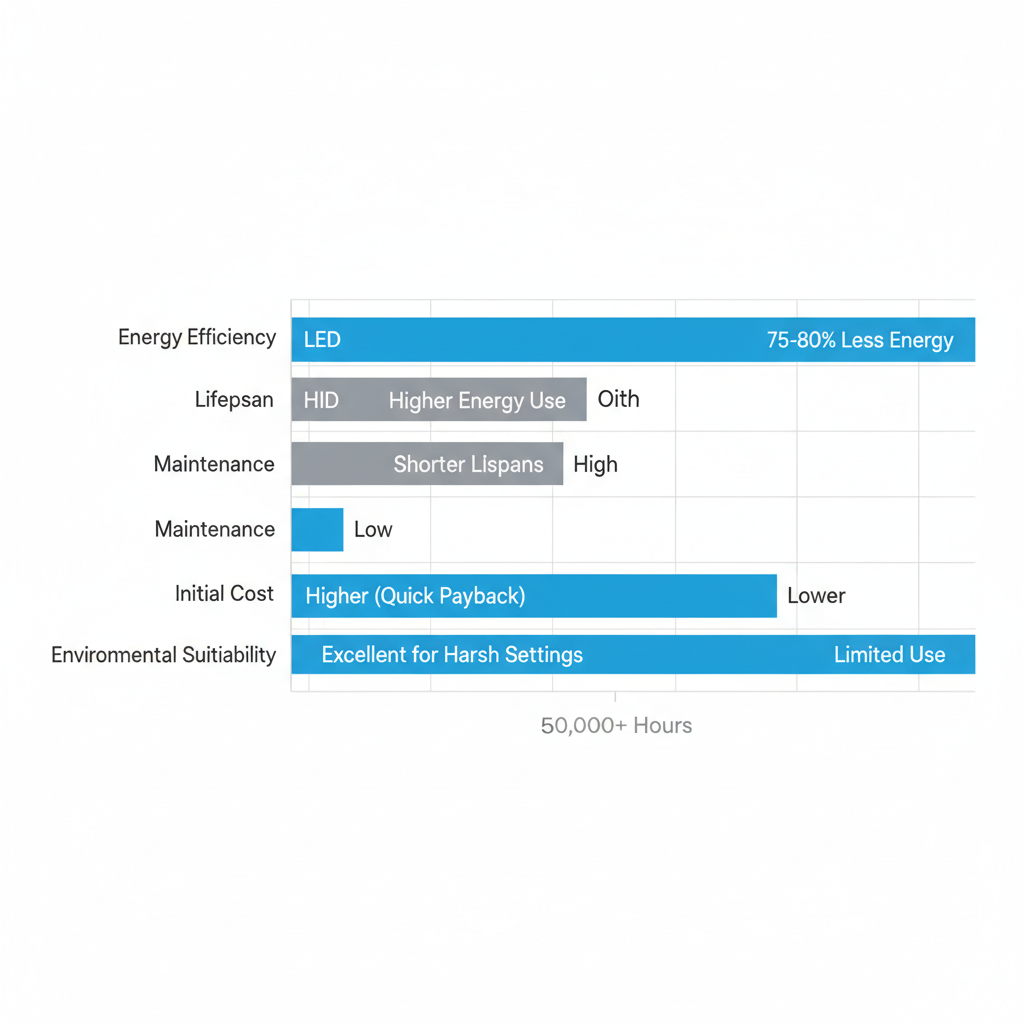
LED vs traditional industrial lighting performance comparison chart
Data from DOE energy standards underscores how these advantages lead to payback periods under two years for Atlanta facilities, as seen in Green Property Advisors’ audit findings. For instance, retrofitting a textile mill in Georgia could yield 60% lighting cost reductions, freeing up capital for other priorities while enhancing overall site efficiency. This comparison not only validates the ROI but also emphasizes why switching to LEDs aligns with long-term cost-control strategies.
Beyond raw efficiency, the lifespan of these systems–often exceeding 50,000 hours–dramatically cuts relamping frequency, a boon for hard-to-reach ceiling installations. Additional perks include instant-on activation for safety in dynamic workspaces and dimmability for tailored output, plus lower HVAC loads since LEDs generate minimal heat. In warehouse applications, industrial led lighting shines by supporting robust LED fixtures for warehouses that withstand vibrations and dust. Key benefits include:
- Reduced downtime from failures
- Eligibility for utility rebates accelerating ROI
- Improved light quality boosting worker productivity
These features make LEDs akin to efficient engines in a facility’s powerhouse lineup, delivering consistent performance without the breakdowns of older tech.
Durability further cements their role in tough settings, with IP65 ratings from sources like Commercial LED Lights ensuring resistance to moisture, dust, and impacts–ideal for factories with heavy machinery. Green Property Advisors guarantees these installations, drawing on proven specs to handle the rigors of daily operations without compromise.
For Atlanta-based operations, consider how LED high bay lights could illuminate vast ceilings in distribution centers, while industrial warehouse LED lighting adapts to expansive layouts for optimal coverage. Green Property Advisors offers free audits to project these savings tailored to your site.
Now that the fundamentals are clear, explore advanced features for optimal implementation in the next deep dive.
Deep Dive into LED Industrial Light Solutions
Building on the fundamentals of industrial lighting, this section delves into specialized LED solutions tailored for demanding environments. High bay and warehouse configurations offer enhanced efficiency and durability, particularly for Atlanta’s bustling distribution centers. Green Property Advisors specializes in these implementations, ensuring seamless integration with local rebate programs for maximum ROI.
High Bay LED Lights for Warehouses
LED high bay lights represent a cornerstone of modern warehouse illumination, providing powerful, focused lighting for expansive ceilings. These fixtures come in UFO and linear designs, with UFO models offering a compact, rounded profile ideal for uniform light distribution in open spaces, while linear variants excel in narrower aisles due to their elongated beam angles of 60 to 120 degrees. Selection begins with assessing ceiling height and coverage needs; for instance, in a typical Atlanta distribution center spanning 30 feet high, fixtures with 20,000 lumens ensure visibility without dark spots. Green Property Advisors recommends evaluating beam angles to match layout specifics, optimizing for tasks like inventory picking.
| Brand | Lumen Output | Wattage | Price Range | Rebate Eligibility |
|---|---|---|---|---|
| Cree | 20,000 lm | 150W | $150-250 | High (utility programs) |
| Philips | 18,000 lm | 140W | $200-300 | High |
| Green Property Advisors Recommended | Custom 22,000 lm | 160W | Project-based with rebates | Full support |
This comparison highlights Cree’s balanced efficiency and Philips’ reliability, but Green Property Advisors’ custom solutions provide tailored lumen boosts and full rebate navigation, making them ideal for Atlanta facilities seeking long-term value. For optimal results, pair these with rebate-eligible models from Georgia Power programs.
Installation best practices emphasize safety and precision. At heights of 15-20 feet, as suggested by warehouse lighting experts, secure mounting with adjustable chains or hooks to allow fine-tuning. Spacing follows a grid pattern, typically 10-15 feet apart based on lumen ratings, while wiring integrates dimmable controls for zoned operation. Professional teams handle conduit runs to comply with local codes, minimizing downtime in active Atlanta warehouses.
The energy benefits are compelling, with payback periods of 1-2 years through 50-70% reductions in electricity use compared to legacy metal halides. Enhanced safety stems from glare-free illumination, reducing accidents by up to 30% in high-traffic zones, while productivity gains include faster order fulfillment in well-lit spaces. For a 50,000 square foot Atlanta warehouse, Green Property Advisors’ retrofits have delivered verified savings of $25,000 annually, underscoring the transformative impact of these advanced high-mount fixtures.
Industrial Warehouse LED Lighting Options
Industrial warehouse LED lighting options prioritize versatility for retrofit integrations, enabling upgrades without full overhauls. Industrial led lighting solutions from Green Property Advisors encompass high bay, strip, and panel varieties, each suited to specific zones like racking areas or loading docks. Retrofit choices include screw-in replacements for existing sockets or hook-mounted units, preserving infrastructure while boosting output. In Georgia warehouses, these selections align with optimized warehouse illumination systems, ensuring compliance with OSHA standards for minimum foot-candles.
Costs vary by scale, with individual high bay units averaging $200, but bulk projects benefit from volume pricing and incentives. Initial outlays for a 100-fixture upgrade might total $20,000, offset by Georgia Power rebates covering 40-60% through programs like the Commercial Lighting Incentive. Financing options allow zero upfront costs, spreading payments over savings–Green Property Advisors handles applications, projecting ROIs via detailed audits. Despite potential tariff influences on imports, as noted in industry guides, domestic sourcing stabilizes pricing at 10-15% below pre-2025 levels, assuring Atlanta clients of predictable budgets.
Maintenance demands are minimal, thanks to LED durability ratings of 50,000 hours. Dust-proof enclosures with IP65 ratings withstand harsh conditions, including high temperatures up to 140°F in unconditioned spaces. Routine checks involve lens cleaning quarterly and driver inspections biennially, extending lifespan beyond traditional fluorescents. Green Property Advisors includes post-installation verification, tracking performance to maintain rebate eligibility and operational efficiency.
Pros of these options include rapid installation under a week for most sites, with no operational disruptions via phased rollouts. Cons involve initial coordination for custom beam angles, though expert guidance mitigates this. For Atlanta industrial clients, tying retrofits to rebate opportunities accelerates adoption, as seen in verified projects yielding 25% energy cuts and improved worker satisfaction.
Practical Steps for LED Retrofit Projects
With solutions selected, here’s how to execute LED retrofit projects efficiently for industrial properties. Green Property Advisors streamlines the process from initial assessment to final verification, ensuring measurable energy savings and minimal operational disruption for clients in Atlanta.
Audit and Proposal Process
Green Property Advisors begins every LED retrofit project with a comprehensive site audit tailored to Atlanta industrial sites. The process starts with a detailed fixture inventory, where technicians catalog existing lighting setups, including types, quantities, and operational hours. Usage measurement follows, employing tools recommended by Super Bright LEDs, such as light meters and data loggers, to accurately assess energy consumption. This step identifies opportunities for LED industrial lights integration, focusing on high-use areas like warehouses and production floors.
- Conduct walkthrough inspections to document fixture conditions.
- Measure baseline energy draw and light levels.
- Identify applicable utility rebates early.
These audits typically take one to two days, with no upfront cost to the client, allowing property managers to evaluate potential without commitment.
Once the audit is complete, Green Property Advisors delivers a customized proposal outlining savings projections and ROI calculations. Proposals include detailed breakdowns of projected energy reductions, often citing up to 40% bill cuts based on DOE guidelines. Payback periods are calculated using real usage data, factoring in Atlanta-specific utility rates from Georgia Power. Each proposal features clear visuals on installation scopes, rebate eligibility, and financing options, empowering clients to make informed decisions quickly.
For many industrial owners facing capital constraints, traditional upgrades seem daunting due to high upfront costs. The following table compares financing models to highlight accessible paths:
| Option | Upfront Cost | Rebate Coverage | Payback Time | Best For |
|---|---|---|---|---|
| Cash Purchase | Full payment | 100% | 1-2 years | Budgeted projects |
| Green Property Advisors Financing | $0 upfront | 80-100% via rebates | <1 year | Cash-flow sensitive |
| Utility Loan | Low interest | Partial rebates | 2-3 years | Long-term savings |
Green Property Advisors’ financing model stands out for its zero-upfront commitment, leveraging rebates to accelerate payback and preserve cash flow. This approach aligns perfectly with industrial clients prioritizing immediate operational improvements over long-term loans.
Transitioning from planning to action, the installation phase builds on these proposals to deliver tangible results. Clients appreciate how this integrated model removes barriers, enabling practical retrofit implementations without financial strain.
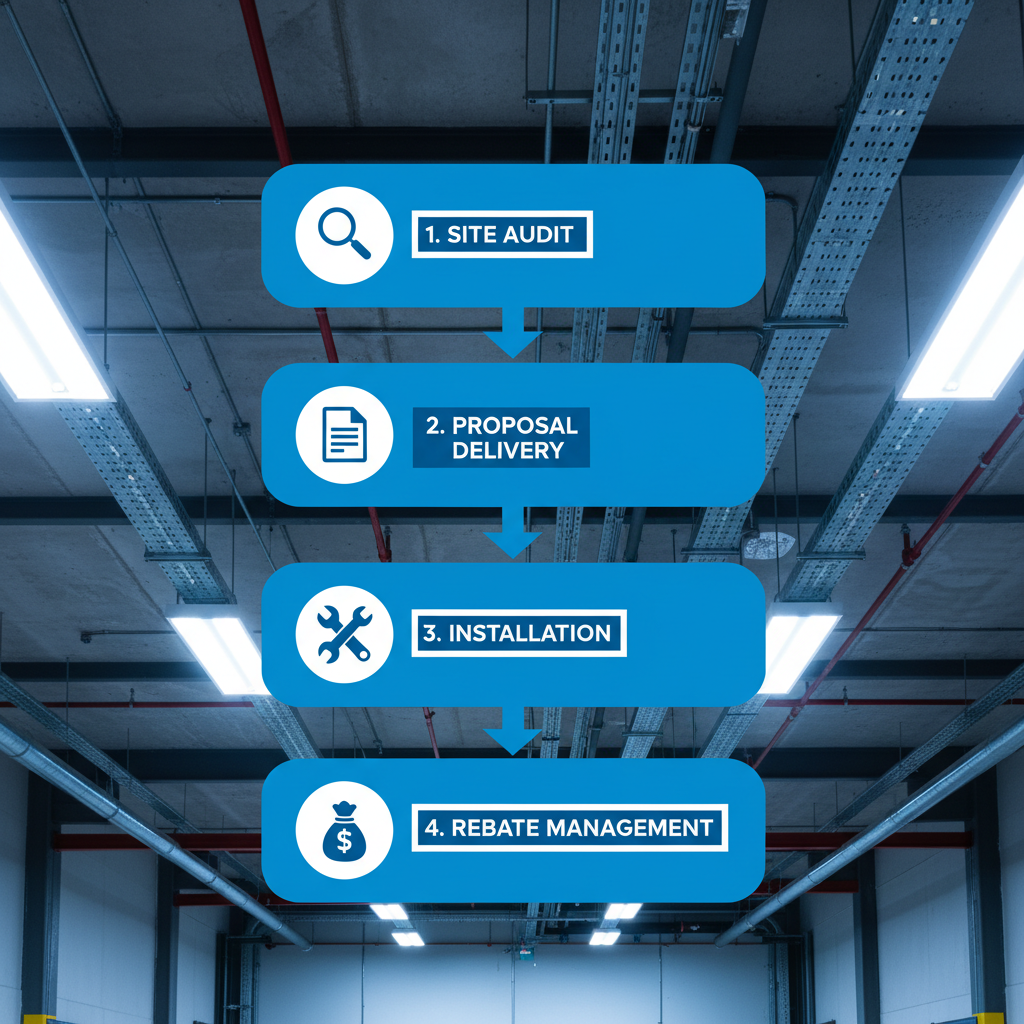
Four-step process for LED retrofit projects from audit to rebate management
This visual outlines the seamless progression, reinforcing Green Property Advisors’ commitment to efficient upgrade procedures.
Installation and Rebate Management
Green Property Advisors handles turnkey installation to ensure zero-disruption upgrades for Atlanta industrial sites. Scheduling coordinates with facility operations, often during off-peak hours, to minimize downtime. Technicians replace fixtures methodically, verifying counts against audit data for accuracy.
In high-ceiling environments, led industrial lighting solutions like LED high bay lights are prioritized for their superior illumination and energy efficiency. Drawing from Commercial LED Lights best practices, installations emphasize dimmable compatibility to integrate seamlessly with existing controls. For example, in Georgia warehouses, crews secure permits through Atlanta’s building department, ensuring compliance with local codes while completing work in phases.
- Prepare site by staging materials discreetly.
- Remove old fixtures and install new ones, testing each for functionality.
- Clean up thoroughly to restore operations swiftly.
This logistics-focused approach guarantees projects wrap within weeks, with reassuring oversight from dedicated project managers.
Rebate management follows installation closely, as Green Property Advisors coordinates with utilities like Georgia Power to secure incentives. Documentation includes pre- and post-install photos, energy logs, and performance metrics, streamlining approval. Clients receive full rebate processing support, often recovering 80-100% of costs, which ties directly to the proposal’s savings projections.
Post-install verification confirms outcomes through detailed performance reports, highlighting reductions in maintenance needs for industrial warehouse LED lighting. Tips include regular cleaning to sustain lumen output and monitoring for any integration issues. These steps not only validate the 40% savings but also provide ongoing guidance for sustained efficiency.
For optimized results, consider these expert tactics in the next section.
Advanced Strategies for LED Optimization
Beyond basic installations, advanced strategies for LED industrial lights unlock substantial energy efficiencies and cost reductions for properties in Atlanta. Green Property Advisors leverages comprehensive audits to identify opportunities in smart LED enhancements, ensuring optimized industrial illumination aligns with operational demands. These techniques focus on automation, integration, and scalability, delivering measurable ROI through reduced consumption and enhanced performance.
Sensors and automation form the cornerstone of energy management in industrial settings. Occupancy sensors detect movement to adjust lighting levels dynamically, while daylight harvesting measures ambient light to dim fixtures accordingly. For zoning in warehouses, LED high bay lights can be segmented by area–high-traffic zones remain brighter, while storage areas dim during low activity. This approach, as per LED Lighting Supply specs, yields up to 30% additional savings via occupancy sensors, minimizing waste without compromising visibility or safety.
The following table compares LED control systems, highlighting base versus advanced needs for enhanced savings:
| System | Features | Cost Add-On | Energy Savings Boost |
|---|---|---|---|
| Basic Dimmers | On/off, dimming | $50-100/fixture | 10-20% |
| Smart IoT Integration | Scheduling, sensors, occupancy | $200-500/system | 30-50% |
| Green Property Advisors Managed | Full rebate-eligible controls, custom | Project-based | 40-60% with audits |
Basic dimmers suit simple setups, but advanced systems like IoT integration provide superior control. Recommending bundling these with retrofits maximizes rebates, as seen in JCLGL’s tariff-resilient smart tech pricing, positioning properties for long-term gains.
Integration with building management systems elevates industrial warehouse LED lighting through IoT compatibility for remote monitoring. Facilities in Georgia properties can access real-time data via apps, adjusting schedules proactively to match production cycles. Partnering with led lighting retrofit companies ensures seamless scalability across multi-site portfolios, incorporating verification metrics from pre- and post-audits to confirm performance.
For scalability, consider an Atlanta factory case study where smart upgrades achieved 50% savings over two years. Key tips include:
- Conduct annual audits to refine zoning.
- Prioritize rebate-eligible IoT for zero-upfront costs.
- Verify occupant comfort through light level metrics.
Addressing common queries next, such as top brands for LED high bay lights in commercial use and rebates for industrial warehouse LED lighting upgrades, these strategies empower informed decisions for energy-efficient options.
FAQ on Industrial LED Lighting
LED industrial lights offer efficient solutions for warehouses and factories in Atlanta. Green Property Advisors helps with retrofits to cut costs and boost performance. Here are answers to common questions.
Q: How much energy do LED industrial lights save?
A: They reduce energy use by up to 75% compared to traditional fixtures, lowering bills significantly for industrial spaces.
Q: What is the lifespan of LED high bay lights?
A: LED high bay lights last over 50,000 hours, minimizing replacements and maintenance in high-use areas.
Q: What are the main benefits of industrial warehouse LED lighting?
A: Key benefits include substantial cost savings, improved safety through better illumination, and reduced heat output.
Q: Are they suitable for harsh environments?
A: Yes, with IP-rated designs, they withstand dust, moisture, and impacts in tough industrial settings.
Q: How do I select the right LED high bay lights for my warehouse?
A: Consider ceiling height, coverage needs, and lumens. Our audits recommend optimal choices for your Atlanta facility.
Q: What about costs, maintenance, and rebates for upgrades?
A: Initial costs vary, but rebates often cover 50% or more per LED Light Expert. As a commercial led lighting company, we handle navigation, low-maintenance installs, and financing.
With questions answered, let’s wrap up.
Taking Action on LED Industrial Upgrades
Upgrading to LED industrial lights in Atlanta facilities delivers unmatched efficiency and longevity, outpacing traditional fixtures by reducing energy use and maintenance demands. These sustainable lighting upgrades ensure brighter, more reliable illumination for demanding environments.
LED high bay lights enhance visibility in high-ceiling spaces, while industrial warehouse LED lighting slashes operational costs through simple retrofits, maximized rebates, and impressive ROI. Zero-upfront financing makes implementation seamless, with guaranteed savings verified post-installation.
Act now to boost your property’s value and cut expenses. Contact Green Property Advisors today for a free audit and turnkey proposal:
- Schedule your no-obligation site visit
- Explore rebate opportunities
- Secure immediate cash flow improvements
According to Super Bright LEDs, expect up to 80% energy savings on industrial setups.